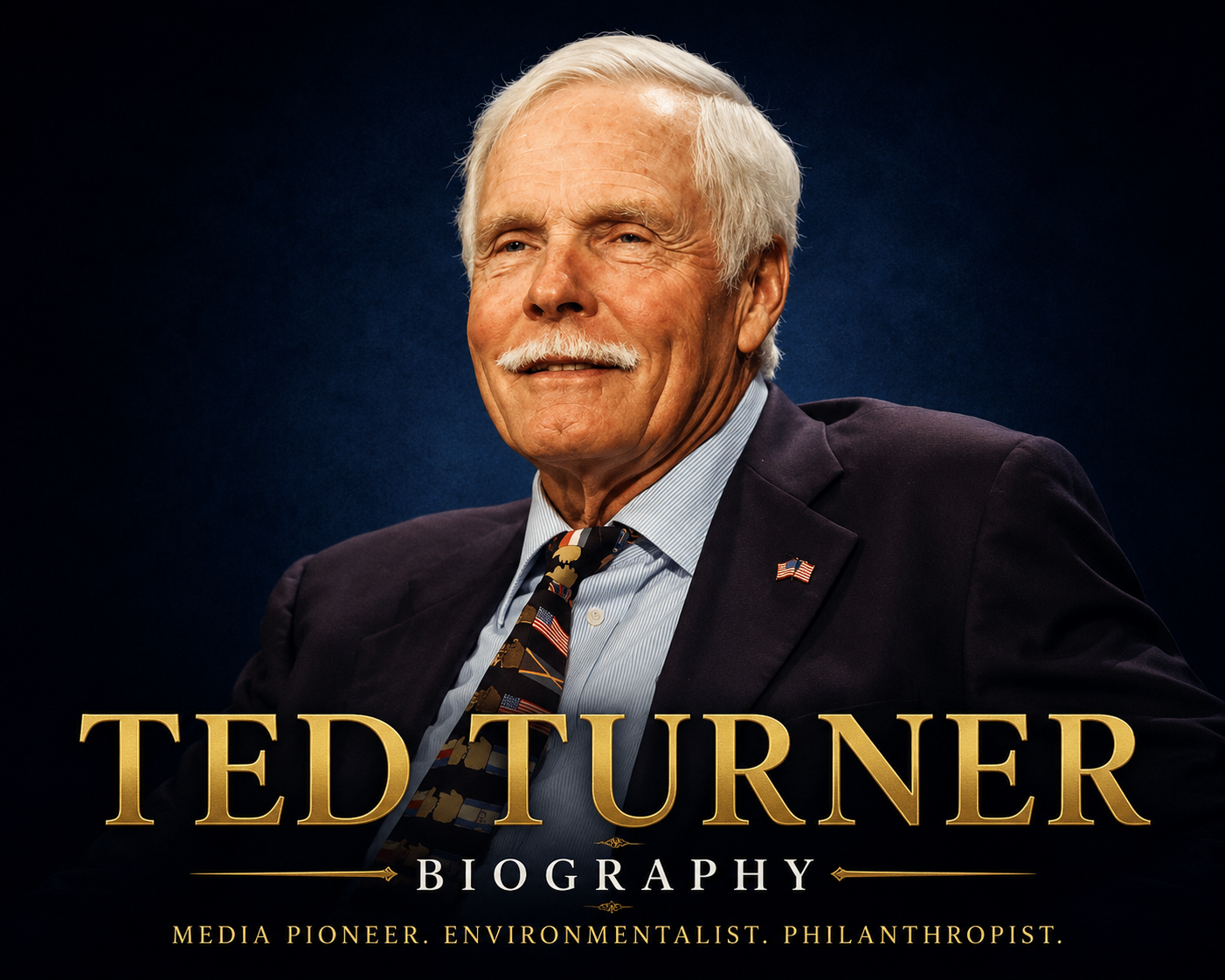
Ted Turner Biography
Ted Turner was an American media mogul, philanthropist, conservationist, and businessman who transformed global television broadcasting through innovation and bold leadership. He became internationally famous as the founder of [CNN](https://www.cnn.com?utm_source=chatgpt.com), the world’s first 24-hour cable news network, which permanently changed how people consumed breaking news and live events across the globe. Turner also built a powerful media empire that included TBS, TNT, Cartoon Network, and Turner Classic Movies, making him one of the most influential figures in modern television history.
Born on November 19, 1938, in Cincinnati, Turner rose from managing his family’s billboard advertising business to becoming one of America’s most successful entrepreneurs. His fearless business decisions, outspoken personality, and willingness to challenge traditional media systems helped him redefine cable television during the late twentieth century. Beyond broadcasting, he also gained recognition as the owner of the Atlanta Braves and Atlanta Hawks, as well as an accomplished competitive sailor who won the America’s Cup in 1977.
In recent days, Ted Turner has become a major topic in global news following reports of his death on May 6, 2026, at the age of 87. Tributes from journalists, politicians, entertainers, and business leaders have highlighted his lasting influence on journalism, media, sports, and philanthropy. Turner is also remembered for his environmental activism and his historic $1 billion donation to support the United Nations, one of the largest charitable pledges ever made by a private individual.
Ted Turner Early Life and Background
Ted Turner was born as Robert Edward Turner III on November 19, 1938, in Cincinnati. He was raised in a strict and highly competitive environment by his parents, especially his father, Robert Edward Turner II, who owned a successful billboard advertising business. During his childhood, the family later moved to Savannah, where Turner spent much of his early years growing up. His upbringing was deeply shaped by discipline, ambition, and hard work, qualities that later defined his business career.
As a young boy, Turner developed a strong personality and a competitive spirit. He attended The McCallie School in Tennessee, where he became known for his intelligence, confidence, and leadership abilities. Although his relationship with his father was often difficult and demanding, the experience taught him resilience and business discipline from an early age. Turner also developed an interest in sailing and outdoor activities during his youth, passions that remained important throughout his life.
After completing his secondary education, Turner enrolled at Brown University, where he initially studied classics before later changing to economics. However, his time at the university ended abruptly when he was expelled before completing his degree. Despite this setback, Turner refused to let the experience define his future. A major turning point came in 1963 when his father died by suicide, leaving the young Turner in charge of the struggling family billboard company at just 24 years old. He quickly stepped into leadership and began transforming the business into what would later become the foundation of his massive media empire.
Ted Turner Education
Ted Turner received his early education in the United States and was raised in a disciplined academic environment that strongly emphasized achievement and leadership. During his childhood, he attended several schools before eventually enrolling at The McCallie School in Chattanooga. The school was known for its strict structure and competitive atmosphere, which helped shape Turner’s determined personality and leadership style. While in school, he showed strong intelligence, confidence, and a natural ability to lead others.
After completing his secondary education, Turner gained admission into Brown University, one of America’s prestigious Ivy League institutions. At the university, he initially studied classics before later switching to economics. His academic interests reflected his growing curiosity about business, leadership, and global affairs. Although Turner was intelligent and ambitious, he became known for his rebellious behavior and independent mindset during his university years.
Turner’s education at Brown University ended before graduation when he was expelled from the institution. Despite not earning a university degree, the experience played an important role in shaping his worldview and confidence. Rather than allowing the setback to limit his future, he redirected his focus toward business and entrepreneurship. His practical business experience, bold decision-making, and innovative thinking later became more valuable to his success than formal academic qualifications. Through determination and vision, Turner eventually built one of the most influential media empires in history and transformed global television broadcasting forever.
Ted Turner Career and Rise to Fame
Ted Turner began his professional career in the billboard advertising industry after taking control of his father’s company, Turner Advertising, in 1963 following his father’s tragic death. At just 24 years old, Turner inherited a struggling business filled with financial pressure and uncertainty. Through determination, aggressive marketing strategies, and strong leadership, he successfully expanded the company and transformed it into a profitable enterprise. This early success laid the foundation for his future ambitions in media and broadcasting.
During the 1970s, Turner shifted his focus from outdoor advertising into television broadcasting. In 1970, he purchased a struggling television station in Atlanta called WJRJ-TV, which he later renamed WTBS. Using satellite technology, Turner transformed the station into one of America’s first national “superstations,” allowing viewers across the country to access its programming. This innovative move revolutionized cable television and established Turner Broadcasting System as a major force in the entertainment industry.
Turner achieved his greatest breakthrough in 1980 when he launched [CNN](https://www.cnn.com?utm_source=chatgpt.com), the world’s first 24-hour cable news network. At the time, many critics believed nonstop news coverage would fail because they thought viewers would not watch news all day. Turner ignored the criticism and continued with his vision. CNN quickly grew into one of the most influential news organizations in the world, especially during major global events such as the Gulf War, the fall of the Berlin Wall, presidential elections, and international crises. The network permanently changed the way people consumed news and live breaking events.
As his media empire expanded, Turner introduced several successful television channels and entertainment brands. These included TNT, Cartoon Network, Turner Classic Movies, and various sports broadcasting ventures. He also became the owner of the Atlanta Braves and the Atlanta Hawks. Under his ownership, the Braves achieved major success and won the 1995 World Series championship, further increasing Turner’s influence in sports and entertainment.
In 1996, Turner made one of the biggest business deals in media history when Turner Broadcasting merged with [Time Warner](https://www.warnerbrosdiscovery.com?utm_source=chatgpt.com). The merger made Turner one of the most powerful media executives in the world at the time. Although he later expressed disappointment over losing some control of the company, his achievements had already transformed the global media industry forever.
Beyond television, Turner built a reputation as a philanthropist, environmental activist, and conservationist. He donated $1 billion to support the United Nations and co-founded the Nuclear Threat Initiative to reduce nuclear dangers worldwide. He also became one of the largest private landowners in the United States and invested heavily in wildlife conservation and bison preservation. His career remains widely respected for its innovation, boldness, and lasting impact on journalism, entertainment, and global broadcasting.
Ted Turner Death and Tributes
Ted Turner died on May 6, 2026, at the age of 87. Reports confirmed that he passed away peacefully at his home in Florida while surrounded by family members. His death came after years of battling Lewy body dementia, a progressive neurological condition that he publicly revealed in 2018.
News of his death immediately sparked global reactions from journalists, media executives, politicians, entertainers, and sports personalities. Many described Turner as one of the most revolutionary figures in television history because of his role in creating the world’s first 24-hour cable news network, [CNN](https://www.cnn.com?utm_source=chatgpt.com). Tributes highlighted how his bold ideas transformed journalism, live broadcasting, and cable television forever.
Former wife Jane Fonda shared one of the most emotional tributes following his death. She described Turner as a “deeply romantic” and visionary man who greatly influenced her life and confidence. Fonda praised his intelligence, humor, passion for nature, and groundbreaking achievements in media and philanthropy.
Several major media leaders and business executives also honored Turner’s legacy. Reports revealed that figures including Rupert Murdoch, Comcast chairman Brian Roberts, and other television executives praised his fearless innovation and described him as a visionary who changed the media industry permanently.
Inside CNN, anchors and journalists dedicated special broadcasts to remembering their founder. Veteran broadcasters including Wolf Blitzer and Christiane Amanpour reflected on Turner’s courage, creativity, and willingness to take risks when launching a 24-hour news channel that many originally believed would fail.
United States President Donald Trump also reacted publicly to Turner’s death, describing him as “one of the greats” while acknowledging his enormous influence on television and broadcasting.
Beyond media, tributes also focused on Turner’s philanthropy and environmental work. Many organizations praised his $1 billion donation to the United Nations, his conservation projects, and his efforts to protect wildlife and preserve millions of acres of land across the United States.
Ted Turner Age, Religion, Tribe, Height and Physical Appearance
Ted Turner was born on November 19, 1938, and died on May 6, 2026, at the age of 87. He was an American citizen born in Cincinnati and later raised in Savannah. Throughout his lifetime, Turner became known not only for his business achievements but also for his energetic personality, confidence, and strong public presence.
In terms of religion, Ted Turner was raised in a Christian background during his childhood. However, as he grew older, he became widely known for expressing independent and sometimes controversial views about religion and spirituality. He often described himself as spiritual rather than traditionally religious and openly discussed his personal beliefs in interviews over the years.
Regarding tribe or ethnicity, Ted Turner was of White American ethnic background with European ancestry. His family roots were connected to traditional American Southern culture, which strongly influenced parts of his upbringing and personality during his early years in Georgia.
Ted Turner stood at an estimated height of about 6 feet 2 inches tall. He had a strong physical build during his younger years and was widely recognized for his commanding appearance, deep voice, and confident body language. In his prime, Turner maintained an active lifestyle through sailing, ranching, outdoor adventures, and sports activities. He was especially known for his passion for competitive sailing, which helped keep him physically active for many years.
As he aged, Turner’s appearance changed due to health challenges, particularly after publicly revealing his diagnosis of Lewy body dementia in 2018. Despite these struggles, he remained respected for his charismatic personality, bold attitude, and influential presence in the media world. His distinctive style, outspoken nature, and energetic public image made him one of the most recognizable businessmen in American television history.
Ted Turner Net Worth
Ted Turner had an estimated net worth of approximately $2.8 billion at the time of his death in May 2026. His fortune was built primarily through media ownership, television broadcasting, sports investments, ranching, and large-scale business ventures. Turner became one of the wealthiest and most influential businessmen in America after transforming a small family billboard company into a global media empire.
A major source of Turner’s wealth came from the success of [CNN](https://www.cnn.com?utm_source=chatgpt.com) and Turner Broadcasting System. Through channels such as TBS, TNT, Cartoon Network, and Turner Classic Movies, he generated massive revenue and helped shape the cable television industry worldwide. His groundbreaking decision to launch the world’s first 24-hour news network became one of the most profitable and influential moves in media history.
Turner’s financial success increased significantly in 1996 when Turner Broadcasting merged with [Time Warner](https://www.warnerbrosdiscovery.com?utm_source=chatgpt.com) in a multibillion-dollar media deal. The merger made him one of the largest shareholders in the company and greatly expanded his personal wealth. Although later corporate changes reduced some of his influence, Turner remained financially successful for decades afterward.
Beyond broadcasting, Turner earned income from professional sports ownership, real estate, ranching, and environmental investments. He owned the Atlanta Braves and the Atlanta Hawks, both of which became valuable sports franchises under his ownership. He also became one of the largest private landowners in the United States, controlling millions of acres of ranch land across several states.
Despite his enormous wealth, Turner became equally famous for philanthropy and charitable giving. In 1997, he pledged $1 billion to support the United Nations, one of the largest charitable donations ever made by a private individual. He also funded environmental conservation projects, wildlife protection initiatives, and nuclear threat reduction programs. His financial legacy was therefore defined not only by business success but also by his commitment to global humanitarian and environmental causes.
Ted Turner Legacy
Ted Turner is remembered as one of the most influential and revolutionary figures in the history of global media and television broadcasting. His biggest legacy came through the creation of [CNN](https://www.cnn.com?utm_source=chatgpt.com) in 1980, which became the world’s first 24-hour cable news network. Before CNN, television news was limited to short scheduled broadcasts, but Turner completely transformed journalism by introducing nonstop live news coverage. His innovation changed how people around the world received information during wars, elections, disasters, and major global events.
Turner also played a major role in expanding cable television and entertainment. Through Turner Broadcasting System, he helped launch and grow channels such as TBS, TNT, Cartoon Network, and Turner Classic Movies. These networks influenced generations of viewers and helped shape modern television culture. His bold use of satellite broadcasting technology also revolutionized how television content was distributed across the United States and internationally.
Beyond media, Turner left a powerful impact in sports and business. As owner of the Atlanta Braves and the Atlanta Hawks, he increased the popularity and national visibility of both franchises. His leadership style, risk-taking mindset, and willingness to challenge traditional business ideas inspired many future entrepreneurs and media executives around the world.
Turner’s legacy also extends deeply into philanthropy and environmental conservation. In 1997, he shocked the world by pledging $1 billion to support the United Nations, creating one of the largest charitable donations ever made by a private individual. He also invested heavily in wildlife conservation, land preservation, and nuclear threat reduction programs. Through his ranches and environmental projects, Turner became one of America’s leading conservation advocates and worked to protect endangered wildlife, including large bison populations.
Even after his death in 2026, Ted Turner continues to be celebrated as a visionary who changed modern television forever. His fearless ambition, innovative thinking, and global influence left a lasting mark on journalism, entertainment, philanthropy, and environmental activism. Many historians and media experts consider him one of the greatest pioneers in broadcasting history, and his influence continues to shape the media world today.
Conclusion
Ted Turner remains one of the most iconic and influential figures in modern media history because of his groundbreaking contributions to television broadcasting, journalism, sports, and philanthropy. From transforming a small family advertising business into a global media empire to creating [CNN](https://www.cnn.com?utm_source=chatgpt.com), the world’s first 24-hour news network, Turner changed how people across the world consume information and entertainment. His fearless leadership, innovative ideas, environmental activism, and massive charitable efforts earned him worldwide respect and recognition. Even after his death in 2026, his legacy continues to live on through the global impact of his media networks, conservation projects, and humanitarian contributions, securing his place as one of the greatest pioneers in broadcasting and business history.
FAQ About Ted Turner
1. Who was Ted Turner?
Ted Turner was an American media mogul, businessman, philanthropist, and conservationist best known for founding [CNN](https://www.cnn.com?utm_source=chatgpt.com), the world’s first 24-hour cable news network that transformed global broadcasting and journalism forever.
2. When was Ted Turner born?
Ted Turner was born on November 19, 1938, in Cincinnati. He later grew up in Savannah, where much of his childhood and early development took place.
3. How old was Ted Turner when he died?
Ted Turner died on May 6, 2026, at the age of 87 after years of battling Lewy body dementia, a progressive neurological condition he publicly discussed during his later years.
4. What was Ted Turner famous for?
Ted Turner became famous for launching CNN and building Turner Broadcasting System, which included successful television networks such as TBS, TNT, Cartoon Network, and Turner Classic Movies.
5. What was Ted Turner’s net worth?
At the time of his death in 2026, Ted Turner had an estimated net worth of around $2.8 billion earned through media ownership, sports investments, ranching, and business ventures.
6. Was Ted Turner married?
Yes. Ted Turner was married three times during his lifetime. His most famous marriage was to Jane Fonda, one of Hollywood’s most respected actresses and activists.
7. Did Ted Turner have children?
Yes. Ted Turner had five children and several grandchildren. Despite his busy business career, family remained an important part of his personal life over the years.
8. What illness did Ted Turner have?
Ted Turner publicly revealed in 2018 that he had Lewy body dementia, a condition that affects brain function, movement, memory, and overall cognitive health over time.
9. What sports teams did Ted Turner own?
Ted Turner owned the Atlanta Braves and the Atlanta Hawks, helping increase their popularity and national recognition during his ownership.
10. What was Ted Turner’s biggest achievement?
Ted Turner’s biggest achievement was creating CNN, which revolutionized television journalism by introducing nonstop live news coverage and permanently changing the global media industry.
11. Did Ted Turner donate money to charity?
Yes. Ted Turner became globally respected for philanthropy after pledging $1 billion to support the United Nations and funding environmental and humanitarian projects worldwide.